Best Straight Razor for Beginners: The Complete Guide (2026)
Straight razor shaving has a reputation for being difficult. It is not. With the right razor and a few weeks of practice, most beginners are shaving better than they ever did with a cartridge. The learning curve is real, but it is short — and the reward is a closer, cleaner shave that lasts.
At DOVO, we have been making straight razors in Solingen, Germany, since 1906. We are the world's largest manufacturer of traditional straight razors, and we have helped more beginners make the switch than anyone. This guide tells you exactly what to look for and which razor to start with.

What to Look for in a Beginner Straight Razor
A good beginner razor is not the most expensive one. It is the one that makes learning as easy as possible. Four things decide that:
Blade Width: Start at 5/8"
Straight razor blades are measured in eighths of an inch. A 5/8" or 6/8" blade is the best size for most beginners. It is wide enough to hold lather and give stability, yet small enough to move easily around the chin, nose and jawline. Wider 7/8" or 8/8" blades suit experienced shavers with a heavy beard; narrow 4/8" blades take more passes.

Point Shape: Choose a Round Point
The point is the tip of the blade. A round point is the most forgiving — it will not catch on the skin if your angle drifts slightly. Square points and Spanish points are precise and beautiful, but they require muscle memory you have not built yet. For your first razor, a round point is not a compromise; it is the correct choice.

Grind: Full Hollow for Feedback
The grind describes how the blade is shaped from spine to edge. A full hollow grind produces a thinner, more flexible edge that "sings" on the skin as you shave — that high-pitched ringing is feedback telling you the angle is right. For beginners, that feedback is invaluable. Wedge and half-hollow grinds are heavier and stiffer; they suit experienced barbers working on strong beards, but they are unforgiving for someone still learning angle control.

Steel: Carbon or Stainless
Most DOVO razors are carbon steel. Carbon steel takes an extremely fine edge and is easy to hone back to sharpness. It does oxidize if left wet, so dry your razor after each use. Stainless steel (our Inox range) is more resistant to moisture and needs less careful drying — a good option if you tend to leave things in a humid bathroom. Both grades deliver an excellent shave; the choice comes down to how much maintenance you want to do.
Shave Ready: The Most Important Word for a New Straight Razor
"Shave ready" means the edge is sharp enough to shave immediately. This is the single biggest pitfall for beginners. Many cheap razors are sold at very low prices, but they usually need to be honed by a professional before they can shave at all. A dull edge pulls hair and causes irritation, and most new shavers then blame their technique.
Buy a razor that is professionally honed, or one from a maker that stands behind the edge. When your razor needs resharpening, Razor Emporium offers a professional honing service in the USA, so you do not have to learn to hone right away.
Best DOVO Straight Razors for Beginners
Every razor below ships shave-ready from our Solingen workshop. You do not need to send it out for honing before first use.
1. DOVO Best Quality 5/8" — The Classic Starter
The DOVO Best Quality 5/8" ($180) is the razor we recommend first to almost everyone. It has a full hollow grind and a round point — exactly the combination described above. The carbon steel blade is ground and finished by hand in Solingen. The black ebonite handle is light, balanced and comfortable for a beginner grip. At its price point, it is the most accessible entry into genuine straight razor shaving without any compromise on quality.
- Blade width: 5/8"
- Grind: Full hollow
- Point: Round
- Steel: Carbon
- Best for: First razor, all beard types

2. DOVO Runde Sache — Built for Beginners
The DOVO Runde Sache ($190, German for "round matter") takes its name from its generous round point — the most forgiving tip we make. The full hollow grind gives clear feedback. It comes in three handle colors (blue, green, red), making it one of the more visually approachable razors in the range. If the Best Quality is the classic choice, the Runde Sache is the one designed with beginners explicitly in mind.
- Blade width: 5/8"
- Grind: Full hollow
- Point: Round (extra-generous)
- Steel: Carbon
- Best for: First razor, beginners who want an accessible design

3. DOVO Best Quality 6/8" — For Stronger Beards
The same razor with a slightly wider 6/8" blade. The extra width holds more lather and adds a little weight, which many shavers with a coarse or dense beard find more stable. A good choice if you have a heavy stubble.
4. DOVO Barbarossa Olive Wood — A Classic with Natural Wood
If you want a razor that looks and feels like a traditional heirloom, the Barbarossa Olive Wood pairs a classic DOVO blade with a warm olive wood handle. Every handle is unique.
5. DOVO INOX — Stainless Option
The DOVO INOX 5/8" with Olive or Ebony wood handles offers round point and full hollow grind with stainless steel that requires minimal maintenance — good if you tend to leave your razor in a damp bathroom.

You can compare all models in our straight razor collection.
Straight Razor vs. Shavette vs. Safety Razor
A shavette uses replaceable blades rather than a honed steel edge. It looks like a straight razor and uses the same technique, but you never need to strop or hone it. Some beginners start with a shavette to learn the grip and angle before committing to a full straight razor.
The honest comparison: a shavette is more forgiving in one sense (no maintenance) but less forgiving in another — a replaceable blade is stiffer and less flexible than a properly honed hollow-ground razor, so it can feel harsher on the skin. Most experienced wet shavers prefer the feel of a honed straight razor once they have learned the technique.
DOVO trademarked the Shavette name in 1985 and still makes the original. If you want to start with replaceable blades, the DOVO Shavette Aluminum ($50) is the reference model.
A safety razor uses a double-edge blade in a guarded head — the easiest to learn and great for daily use, but not the same experience as a straight razor shave.

Do You Need a Strop?
Yes — and this is not optional. A leather strop is the tool you use before every shave to realign the blade edge. Without stropping, a straight razor dulls within a few shaves and begins to drag rather than cut cleanly.
Stropping is not sharpening. A strop does not remove metal; it straightens the microscopic burr on the edge that forms through normal use. The motion is a slow, light draw — spine leading, edge trailing — repeated 20–30 times per side before each shave.
A good beginner strop is a hanging leather strop around 2–3 inches wide. The DOVO Kabara strop is a reliable first choice. If you would rather not buy separately, the Expert Set includes a strop alongside the razor and care accessories.

What Else You Need to Start
– A shaving brush and quality shaving cream or soap. A thick lather protects the skin and lifts the beard.
– A hone (later). Every straight razor needs to be honed now and then, usually every few months. Many beginners use a professional honing service at first, then learn to hone with a whetstone once they are comfortable.
How to Start Straight Razor Shaving
Five steps for your first shave:
- Prepare your skin. Shower first or apply a warm damp towel for two minutes. Warm water softens the beard significantly — this single step makes more difference than most beginners expect.
- Strop your razor. Twenty passes per side on a hanging leather strop, spine leading, light pressure.
- Lather thoroughly. A good shaving soap and brush gives you thick, slick lather that lets the blade glide.
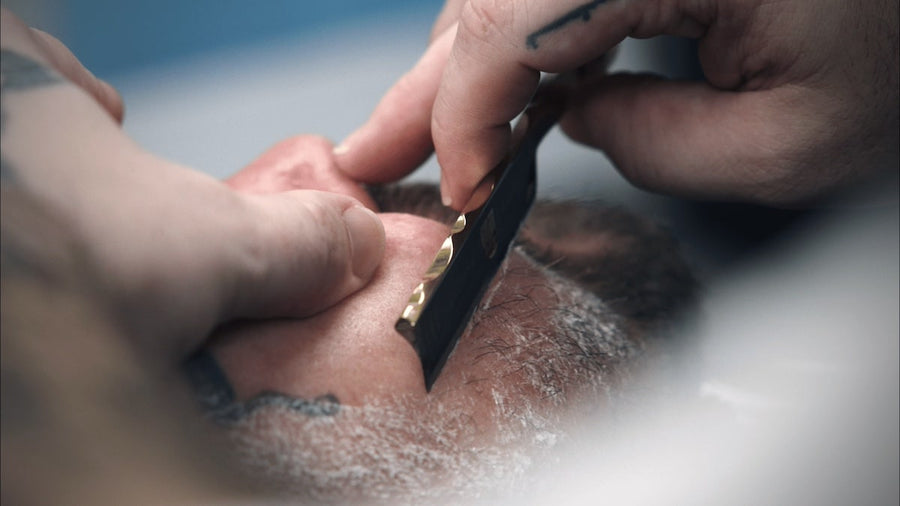
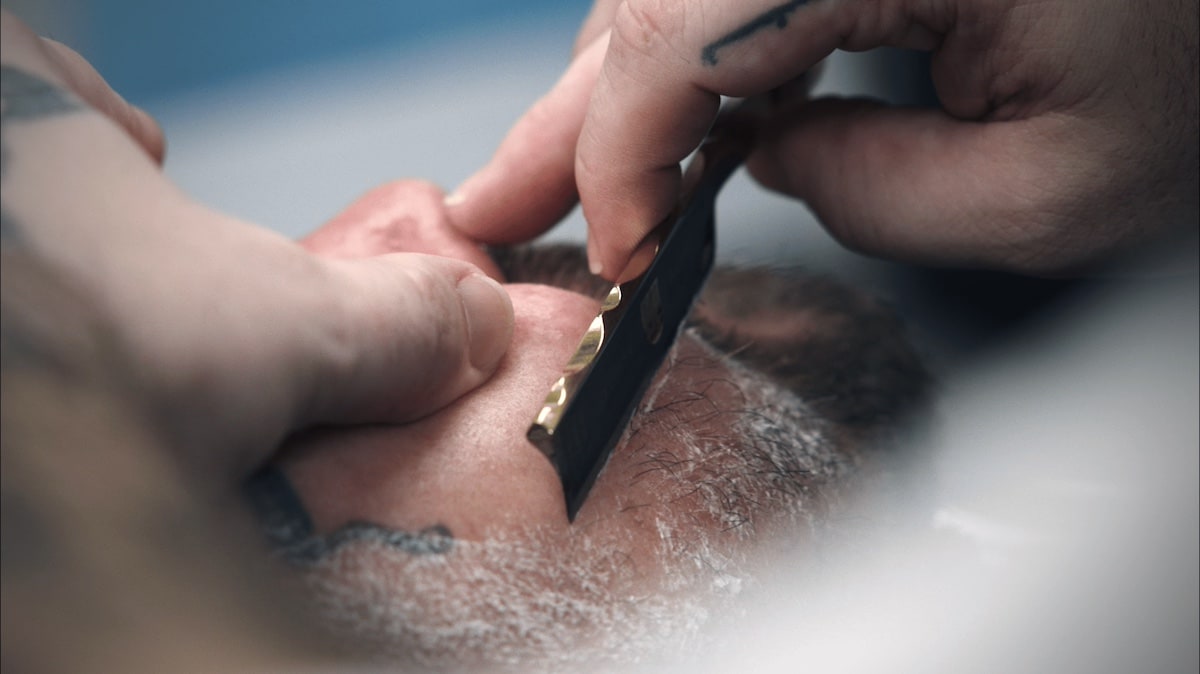
- Shave with the grain first. Hold the blade at approximately 30 degrees, pull the skin taut with your free hand, and use short strokes. Shave with the grain on the first pass. A second pass across or against the grain comes later, once you have the angle consistent.
- Rinse and dry. Rinse with cold water, pat the blade dry, and store it open or with the blade slightly open to allow air circulation.
Read our full technique guide for detailed instruction on angles, strokes, and how to handle the neck and upper lip.

Common Beginner Mistakes
Almost everyone who picks up a straight razor for the first time makes the same few mistakes. Knowing them in advance saves you nicks, irritation and frustration.
1. Pressing Too Hard
Cartridge razors teach you to push. A straight razor needs no pressure at all. Let the weight of the blade do the work and simply guide it across the skin. If you feel the edge dragging, the angle or the lather is wrong, not the pressure.
2. Holding the Wrong Angle
Too steep and the edge digs into the skin; too flat and it skates over the hair without cutting. Aim for about 30 degrees, roughly two spine-widths between the spine and your face, and check the angle again each time you change area.
3. Stropping the Wrong Way
On the strop, the spine leads and the edge trails — the opposite of shaving. Keep the strop pulled taut, keep the blade flat and roll it over its spine at the end of each pass, never over the edge. A slack strop or an edge-first stroke rounds the edge in seconds.
4. Starting with a Dull Razor
A razor that is not shave ready will pull, tug and irritate no matter how good your technique is. Many beginners blame themselves when the blade is the problem. Start with a professionally honed razor and strop it before every shave.
5. Skimping on Preparation
A dry beard and thin lather make even the sharpest razor feel harsh. Soften the beard with warm water or a hot towel, then build a thick, creamy lather with a brush and work it well into the stubble.
6. Not Stretching the Skin
Loose skin folds in front of the edge, which is where most nicks happen. Use your free hand to pull the skin flat and taut, especially on the neck, the jawline and around the chin.
7. Going Against the Grain Too Soon
An against-the-grain pass gives the closest shave, but it is also the easiest way to cut yourself. For the first weeks, shave only with the grain. Add an across-the-grain pass once you feel confident, and save against the grain for later.
8. Rushing and Doing Too Much at Once
A straight razor shave takes time, especially in the beginning. Do not try to shave your whole face on day one. Start with the cheeks, finish the rest with your usual razor, and add a new area every week or so.
9. Neglecting Aftercare
Carbon steel blades rust if they are put away wet. Rinse the razor, dry it carefully without touching the edge, let it air out with the blade open and apply a drop of oil if you will not shave with it for a while. Never leave it in a damp bathroom.

Frequently Asked Questions
Is straight razor shaving hard for beginners?
The first few shaves take concentration, but most beginners are comfortable with the technique within two to three weeks. The key variables are angle (around 30 degrees) and skin tension. Easier than learning to ride a bike — and a lot more satisfying.
What is the best starter straight razor?
For most beginners: a 5/8" carbon steel razor with a full hollow grind and a round point. The DOVO Best Quality 5/8" and the DOVO Runde Sache both meet this specification exactly. Both ship shave-ready from our Solingen workshop.
Do I need a strop as a beginner?
Yes. A leather strop is not optional — it is part of using a straight razor correctly. Use it before every shave. It takes about two minutes once you know the motion. Our stropping guide covers the technique step by step.
How long does it take to learn straight razor shaving?
Most people are shaving confidently within two to four weeks. The first shave is careful and slow. By the tenth shave, the grip and angle are becoming muscle memory. By the thirtieth, it feels natural — a meditative ritual that becomes the highlight of the morning.
Are vintage razors a good choice for a first straight razor?
A vintage straight razor can be excellent, but its condition is hard to judge. Unless it has been professionally restored and honed, a new straight razor is the safer choice.
Ready to Start?
A DOVO straight razor, made by hand in Solingen, is built to last a lifetime and outlast any cartridge or subscription razor you will ever buy. The Best Quality 5/8" is where most beginners start. The Runde Sache is designed with beginners explicitly in mind. The Foundation Set is where they go when they realize this is a long-term habit.